Open transcript
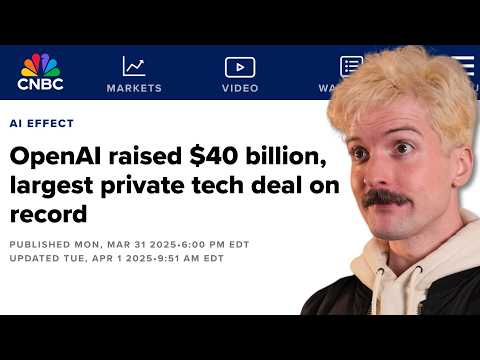
OpenAI just achieved AGI. Well, not quite. They got the next best thing. $40 billion of money raised against a $300 billion valuation. While it's not AGI, they claim it's going to help them significantly with getting there. And there's a lot to talk about here. From the history of how OpenAI got where they are to what it means to raise money like this, what does this $300 billion even mean? And what's the long-term impact of a company like OpenAI having the largest private tech deal in known history? There's a lot to think about here and a couple pieces that I haven't seen anyone else cover. And I'm really excited to break down what this means for the future of AI startups and how the whole fundraising thing works for those who don't know it. I didn't just raise $40 billion. Someone's got to pay my bills. So quick word from today's sponsor, and I'll get right back to it. I still remember the days when auth was easy. You just added an email and a password field to your database and moved on. But nowadays, that's not the case. From SSO to SAML to all the weird compliance stuff you're going to have to handle when you start working with other companies and other teams, it is not fun to set up auth nowadays. Unless you use today's sponsor, Clerc. These guys have made auth so much easier for me and many, many other companies. Clerc's the auth provider I use for most of my products, from upload thing to pick thing to marker thing. And it has made all of those way simpler to build. Not just because it can plug the auth in for you, but the combination of separating your user table from everything else is a thing I actually have learned to love, but also all the UI stuff they handle for you to you just get components in react that you can go mount in your app to have all the pieces of the auth UI handled without any additional effort. And this is important because there's a lot of weird compliance things around how you have to put the Google logo and show it in certain ways, or you might get banned by Google. It's insane. What if you don't have to deal with any of that? Yeah, it's a good deal. They integrate into almost every major framework really, really well. Obviously, it's the best solution for Next.js. And it's not even close. And one more small thing. I just I love this. And I think it really shows how much Clerc cares. They give you 10,000 users per month for free. But that's not just someone hit sign in and bailed. They actually have a catch one that benefits you greatly. If a user doesn't come back for over 24 hours, they don't count towards that number. This means you don't have to worry about a huge surge of traffic causing your bill to spike because those users aren't real, it won't count towards it. This is a huge change that's actually saved a bunch of our products a ton of money like uploading because users sign in, set it up and then don't go back to the dashboard. So unlike other auth providers that charge more aggressively per user, not a problem here. Clerc's been my auth platform of choice for over three years. Go figure out why at soydev.link slash Clerc. So before we dive too deep, let's read their post about this. And then I will dive in. Today, we're announcing new funding 40 billion at a 300 billion post money valuation, which enables us to push the frontiers of AI research even further, scale our compute infrastructure and deliver increasingly powerful tools for the 500 million people who use ChatGPT every week. We're excited to be working in partnership with SoftBank Group. Few companies understand how to scale transformative technology like they do. Their support will help us continue building AI systems that drive scientific discovery, enable personalized education, enhance human creativity, and pave the way towards AGI that benefits all of humanity. Very interesting. SoftBank tends to come in super, super late. And as always, they're coming in late as hell on this one. $40 billion is a ton of money. $30 billion of it was from SoftBank. And 10 bill was a syndicate of additional investors, other people, companies, firms, etc, all investing in. In order to understand what these numbers all mean, we need to better understand a bit about how fundraising works for early stage private companies. First, we need to understand is that $300 billion number, the valuation is effectively made up. The reason that number is made up is its value that doesn't exist. If there's a company that has stock on the stock market, then any person can buy and sell that stock. When a company is private, you can't just sell it. I'm going to break this down using, rather than open AI, something a little more personal, which is the way that Peng, which is the owner of T3 Chat, my company, is split up. This is T3 Tools, Inc. T3 Tools, Inc. has a valuation that is a number. We'll give it a nice round one. We'll say it's worth $10 million. The company itself is split in half. Half is Theo's, and half is my CTO, Mark's. Technically speaking, there's a bit more on the end here that is for stock grants for some of our other employees, many of which aren't working with us anymore, sadly. But for the most part, it's like 48-48 split between Mark and me. But we did raise money. We went through Y Combinator. We raised a bit of money afterwards. So there's a chunk at the end here that technically speaking will belong to our investors. There's a catch though. We didn't raise using traditional stock. We use a thing called the SAFE. The SAFE stands for Secured Against Future Equity. That means that effectively, our investors wrote us an IOU. Let's say our investors came in as a group. We'll call it Z Combinator. And Z Combinator gave us $1 million on a SAFE against a $10 million post-money valuation. Most of these terms probably mean nothing to you other than the money. So let's break down what it means. If we split this so it's not just Mark and me, but it's instead the box that is the company. When we raise money at this $10 million post-money valuation, it means we take a split here. We'll say this part is the $1 million. And what's left is $9 million. What this means is this $1 million that was bought by the investors, that was invested in the company, this is owed to them, which means they have this 10% of the company because they get the 10% based on what the valuation is here. And this $9 million is a number we made up as agreement saying this is theoretically worth up to $10 million. But it's theoretical. So now Mark and I are split across that $9 million, where instead of us both owning 50% of a $10 million company, we both own 50% of a $9 million company. And the investors own 10% of this last bit here. The important thing to know here is that this all is made up at this point. Our company isn't worth $10 million or whatever our last valuation was because you can't come and buy it. A value means nothing if you can't execute it. If somebody came up to me and wanted to buy 10% of my company for $1 million, I would tell them to fuck off because we're worth a hell of a lot more than that right now. And if we weren't in the middle of raising a round, then it doesn't really matter what offer you come with. I'm just going to say no. Considering the amount of money that T3Chat is making and the size of our growth, our valuation is a hell of a lot higher than $10, $20, $50, probably even $100 mil just because our growth is insane right now. Our numbers are unbelievable. It's making money that disgusts me. So what happens when we do our next round? Let's say we go straight to the stock market and we're actually worth $100 mil. Now this chunk is worth $90 mil and Mark and I are going to have a great day splitting that $90 mil between us. This chunk is now worth $10 mil. Awesome. A plus. They just 10x their money. They're happy. We made a whole bunch of money from nothing. We're happy. But someone has to pay this $100 mil. It has to come from somewhere. It could be that we go on the stock market and sell a bunch of stock. It could be that we get bought out by a company and they trade us money and stock from their company for ours. Something has to make this number real because right now it is a theoretical. Founders of these really big successful companies don't actually have a lot of money unless they sell some of their chunk early or, more common, take $100K from the bank and I'll back it against this valuation of my company. So now if I don't pay you back, you can just take this chunk of my company instead. Very common for venture-backed loans to exist for founders that want more money. I'm lucky. I make money on YouTube. I'll never need to do things like this. But what happens if it goes the other way? What happens if instead of being bought out for $100 mil, we get bought out for $1 mil? That investor from earlier invested $1 mil. So does their $1 mil now become $100,000? No, this is a valuation cap that they invested on. I should add that here. This investment for $1 million on a $10 mil cap means that if we're worth more than $10 mil, it converts as though we were worth $10 mil. So this $1 million becomes 10% if we're worth $10 mil, $100 mil, a bill, $10 mil, $100 mil, whatever. This will be a win for the investors if we end up being worth more. But if we're worth less, this word cap matters a lot. Let's say we'll be a little more generous. Let's say we're worth $2 mil. Their investment now becomes 50% of the company instead because they are investing based on a valuation that doesn't exist. So if the valuation is being less, they end up with half. And now Mark and I are split between the $1 mil remaining. And if it turns out we're only worth $1 mil, then the investors just get the whole thing. And despite the years we put in, if our companies bought for less than we had invested in it, we make nothing. So let's change all these numbers from M's to B's. If my company raised a billion dollars against a $10 billion valuation, you might feel great. You have a billion dollars in the bank. But if you get sold for anything less than that, you get zero. You could spend years running a billion dollar company. And if you don't come out on top of that, if you don't come out worth more than you raised, you get literally zero for that. One more important detail to note about all of this is that OpenAI is transitioning from a nonprofit entity to a for-profit entity. Because again, of that weird cap on the investment and all of that, they have historically been run very weird. And they are in the chaotic process of transitioning into a traditional business. In order for this $40 billion investment to go through, they have to complete that transition by the end of the year. Apparently, if they don't do this transition, SoftBank might go back all the way to $20 billion instead of $40. Oh, no. This gives them an accelerated deadline for OpenAI to pull off its complicated transition. If it was under a two-year deadline from its last round of financing with investors. Startup said a transition to a for-profit entity is required to secure the capital and need to develop the best AI models. They did not respond to Reuters for a comment. All makes sense. The realistically speaking, as insanely complex as this transition is going to be for them, $20 billion can pay for a lot of lawyers. So they're probably going to pull it off. And the fact that they so confidently announced this fundraise means they think they are good. What does this mean for everyone else? Good question. Well, the first piece I want to focus on is this post-money bit. The way I describe this is technically we were worth $9 million. Then we raised a million. So if we have a $9 million company with a million in the bank, we end up with $10 million total. That's what post-money means. Pre-money means it's a $10 million company. You invested a mil. Now we're an $11 million company. So instead of getting 10%, you get slightly less. Pre-money is pro-founder terms because it means raising more money gets you less. So if you invest in my company thinking I'm only going to raise a million, but then I raise $5 million instead, you get a smaller percentage as a result. And that sucks. As such, for the most part, we like post-money valuations as investors. And it is an industry. We lean towards post-money because it makes the math easier. It means you can raise more money without hurting previous investors. And everything is hunky-dory, happier overall. The post-money valuation is what OpenAI just raised. So technically speaking, they're not a $300 billion company. They're a $260 billion company with $40 billion that they just added to their bank account. So that's the first piece I want to make sure we understand is OpenAI's value isn't $300 billion. It's $260 billion, but they also have $40 billion in the bank. And chances are they have more in the bank, which means that all counts against their value. But as money in the bank, it's even better. Apple has trillions in the bank, literally. So their valuation is weird because they could buy back half their stock right now and it's fine. That's the first thing we need to understand. $260 billion is OpenAI. $40 billion is what was just effectively claimed by that investment. But that's not the only investment that has happened. There's also $13 billion here that came from Microsoft. There's also other smaller investments that came from others. Many of those are capped in a different way that's very, very unique to OpenAI, which is up until recently, returns for investors were capped. This is a very unique thing to how OpenAI raised money that I've never seen before. It's part of the whole like they're technically a charity thing. If we took my example from here, bump this back to the 10 mil, the investors get their one mil at 10%. If we then ended up being worth a thousand mil, which is a bill, we 100x our valuation. That means they get 100x their investment. They get 100 mil for the one mil they put in because we're worth 100 times more than when they invested. The thing that makes OpenAI's stuff unique is once the investor has made enough back, they get hard capped. And essentially they have stops staying still. It goes down. So when we hit 100 mil, they go from 1 to 10. Actually, I want to break this down like in the different states it'll be in. I'm going to remove the Theo mark. Let's color this. So the point here is that the green is what you own and the red is what the investors own. So the investment happens at this one mil val. Company's worth 10 mil. The founders or whoever else there has nine mil. Technically, they can't execute on this. This is all theoretical value here. As I said before, if we end up being worth two mil, this ends up being split accordingly. Hopefully that's a 50-50 split. It's close enough. You get the idea. Also of note, this would shrink horizontally because it's less money. But I'm just going to leave it the same scale because it makes my life easier. Cool. If it was two mil, they still have their million dollar stake at 50%. We end up with less of the company. Here we own 90% of the company. Here we now only own 50% because we didn't come out successful enough. Where things get more fun is what if we did? What if we were actually worth 100 mil? Now, the percentages are going to be the same. I'm just going to copy paste this to show that. It's going to be the exact same split as we had at the start. But these numbers are all going to have a zero added. Very nice and handy. If we ended up being worth more than that, if we ended up being worth a bill, then Mark and I have a really good time ahead of us. The thing that makes OpenAI weird is what happens here. Since they have these special terms, they want to be a nonprofit, by the books at least. If they had done the exact same investment stuff, but with that 10x thing, then that one mil can only go up to 10 mil, which means at this point, their investment gets significantly smaller as a percentage of the company. Their percentage of the ownership goes down as we raise more money because they have maxed out how much they can make from their investment. And this is a very, very strange mechanic that hasn't existed as far as I know in any other startup in history. It's very, very strange. Where this does actually happen a lot is in game investment. I recently started investing in games, so I know a lot more about this now. Usually when you invest in a game, the terms will look something like this. They give 100k towards dev. Investor gets 70% of rev anew until investment 3x. Investor gets 10% of revenue indefinitely. So when I invest in a game, I might hand them $100,000. They then rush to get the game out. Once the game is out, I'll take 70% of what it makes until I've 3x my money. Then from that point forward, I get a much smaller percentage. These numbers are all exaggerated, but rough idea. It's something like this. That's a good way to put it from chat. I don't watch Shark Tank much, so I don't know how to reference that. It's a capped royalty, yes. Capped royalties are very, very unusual in early stage companies. They mostly happen in media and services, things like a game being released. And even then, it's weird, very uncommon. It's part of why Mr. Wonderful is such a meme, because any real investor looks at his way of doing things and is like, what the fuck are you doing? That's so weird and difficult for no goddamn reason. The problem with these investment strategies is that they prescribe a specific way the business has to run. And let's say a third of the way through the development of the game, they decide it'd be better to make an engine instead. How does that work for me? Very strange. Very strange and unusual. As such, this only works with very fixed, straightforward, well-planned businesses. So we don't see it a lot in the venture capital world. Usually what we do is similar to what I just described with the SAFE investment. Also of note, at the SAFE, this equity doesn't exist. If you invested in a SAFE for my company, which is what Y Combinator did and what all of our early investors did, technically right now they own zero of the company. They have an IOU for a future event. The future event is usually something like a Series A raise where we have companies coming in and like buying stock in the business. At that point, their IOUs get converted into real stock. That hasn't happened yet. OpenAI has had that happen. There are people who own real stock in OpenAI at this point. They can't do anything with it, but they do technically have shares that are allocated to their names. They can go to a table somewhere where it's vested and says, this is owned by Microsoft. Thus far, we've mostly been talking as though you only raise money once. Let's grab this chunk again and describe how things change over time. So we have the 10 mil value. Nine mil is ours still. The one mil is someone else's. And let's say we're going to do another raise. This time, we're doing really well. The world perceives us as being worth $100 million, theoretically. That means it's 90 mil, 10 mil, right? Not that simple. Because the point is, we're doing another raise. So this is the default split, but we want to raise more money. Let's say we want to raise another 8 million. This 10 mil gets shifted down. We need to raise a bit more. We need that 8 mil. So that gets appended here to the end. We have this 8 mil from this new investment. Previously, we had sold 10% of the company. That 10% is still here. It's just worth more now. But now we have this additional 8% we sold, which means we don't have 90 mil. We're worth 82 mil. And another raise happens. We go down the chart. Now we're worth or we're raising against a billion. By default, again, we just add zeros to all these numbers. I'm going to have to make them smaller so it all fits. First investment is now worth 100 mil. Second investment is now worth 80 mil. We're raising more money. We're raising another $50 million, let's say. Well, time to start cutting. Move this down. Move all of these down. This smaller block at the end here. Oh, no. That 820 mil is not 820 anymore. Now that is 770. Now, is it terrible and awful that I went from a theoretical 9 million to a theoretical 770? No. But my percentage of the company has gone down a ton. I went from owning 90% of it to owning just barely like 70%. And this will keep happening over and over until you end up owning way less of the company. I also intentionally use much smaller numbers here. Usually the number ends up being over 10%, not less than 10% during like sequential rounds. So OpenAI here was 40 bill on 300 bill. What this means is SoftBank putting in their 30 now owns 10% of OpenAI. So 10% of OpenAI is now owned by SoftBank. The other 10 bill was split across a bunch of other people, but that's 40 bill, which is a little over 10%. It's closer to like 12.5% of OpenAI was just sold effectively. There is one other catch here though. What happens if I need more money? What happens if I spent all of this? Because remember, I didn't get $230 million. I got $1 million. Then I got $8 million. Then I got $50 million. So I only technically raised $59 million. And chances are, as I got to each of these stages, the reason I raised again is I was running low on money. Early stage companies, shocker, lose money most of the time. It's very rare that early stage companies are actually profitable, like incredibly so. And if they are, that usually means they have an opportunity to spend more money in order to grow faster in order to become bigger. Because generally speaking, the things that are in this VC world are winner takes all. Being the seventh biggest social media site doesn't matter because one through three have 90% of the traffic. Being the 15th biggest AI company probably doesn't matter because one through three are going to be the models that everyone is using. So even though my company is theoretically worth a billion dollars, we've only total raised $59 million. We've probably been spending money throughout. And importantly, we might be running low on that money, especially at this point where we only raised $8 million at this valuation. Now we're probably going pretty close to broke depending on how we're spending and allocating our funds. So we raised $50 million. Oh my God, we have so much money. We've only ever seen a seven digit number. All of a sudden we have a big eight digit number in the bank. We should spend it. We should do more marketing. We should double the team size. We should finally hire designers. We should buy a billboard. We should do all these things. And all of a sudden that $59 million goes to zero too. So now we are back to having no money in the bank. We need to raise again. What happens if no investors agree to a $10 billion valuation? What if instead those investors agree to, I don't know, 800 mil? This is called a down round. Down rounds suck because these percentages aren't going to go down. Once these are locked in, they're locked in. That gets converted every step along the way. So they're keeping their percentage. So just from this, we haven't even added the extra money yet. Just from here, the one bill to 800 mil, that means you just lost $200 million flat out just by that alone, just by taking the down round. You haven't even inked the new deal yet, but we need another 50 million. That 50 million is going to get 800, which should be able to do that math quickly. It's like 6.25%. Cool. We can go with that. But that also means shorter shifted. All these percentages need to go up now because 100 over 800 is one eighth, which is 12.5. What my mental math would have said. 12.5. 80 is now 10% in the 50. So this one's now worth 6.25. And the new investment we just did is two. That sucks. We got $50 million, but we lost $200 million. That's kind of insane if you think about it. That we just raised $50 million. So we added $50 million to our bank, but we somehow evaporated $200 million in that process. This is why you never, ever, ever, ever, ever want to take a down round. Once you have hit a certain valuation, if you ever raise on a lower one, good chance your company's going out of business because you just took a huge hit to the percentage of the company you own because you are that desperate for money. And the investors know this too. When they see that you're that desperate, that you're willing to take a down round, they're going to play hardball. They're going to squeeze every little bit of a percentage they can get out of you. And even worse, a lot of these investors are going to start looking for their outs. They're going to start bugging you saying, hey, can we sell? Can we sell? Can we get rid of this? We have buyers. We want to get rid of it. Help. You do not want to be in that position. You'd not want to be in a position where your company is worth less than it was prior. And all of the people who currently own parts of it want to liquidate them. Suddenly, you're no longer running a company. You're running a liquidity event that you're trying to keep people holding on to. This is when you go from building a real business to feeling like you're running a crypto scam. And it's not a fun position to be in. I've talked to a lot of founders who are in these places. Usually what they end up doing is going until they're out of money and shutting down. And then everyone goes to zero, which sucks even harder. So what does this $300 billion that OpenAI just raised against actually mean? As CNBC mentioned, this is the largest private tech deal on record. So what this actually means is OpenAI can't really raise money anymore. It is incredibly rare for a company to be worth that much money and not be on the stock market. Basically unheard of. For reference, a company like Ford, the carb makers, are worth about $40 billion. And that's a stock you can go to the stock market and buy. This is a realized value. OpenAI is worth almost 10 times more, but we don't know if that stock is real or not. We don't know if this went public. Would whatever is not owned by the investors be purchased by people or not? Would these investors all immediately sell and cause the price to go down? Because right now this valuation is effectively locked in because no one can do anything about it. When somebody invests in OpenAI, they're effectively making a bet that OpenAI will sell, become profitable, or go to the stock market and this $40 billion portion they own can then be sold to somebody else. Maybe partially, maybe fully, maybe whatever. This stock doesn't exist properly though, which makes this number kind of insane. The biggest deal with this number is that they can never really raise money again. No investor in the right fucking mind is going to go in on a valuation higher than this. Even this one's kind of insane and it makes sense that SoftBank were the ones to jump on it. I cannot imagine any other fund being willing to pour that absurd amount of money into something, not knowing what the next step is. The harsh reality of this investment is that, effectively, OpenAI has to succeed with the money they have now. They can't really keep fundraising. They can't really keep playing these games. For OpenAI's investors to not want to literally murder them, bring them to court, and ruin their lives, they effectively now have to hit their goal. And as they stated in their announcement, new funding to build towards AGI. This investment needs to be the one that gets them to that goal. They need to hit AGI with the $40 million they just put in the bank, because if they don't pull it off, they're screwed. There is one more important piece here I think is worth talking about. This investment didn't just happen. It just got announced. We don't actually know when this investment happened. This investment could have happened this week. It could have happened three months ago. It could have happened years ago. Chad is coming up with something pretty important here. It could have happened before DeepSeek. Exactly. We don't know. We have no way of knowing when this investment happened. There's only a few reasons you announce how much money you've raised. Remember, this is a private company. You're under no obligation to publicly announce your fundraisers. Your investors need to know, but no one else does. Your employees probably need to know. I don't know the rules there, obviously. I think you should tell them. So why would you announce? Reason one, you want investors to know you raised money. Why would you want investors to know you raised money? Because now they know you're going to need to raise more eventually. But if OpenAI just announced a raise they can't really top, I think it's very unlikely they're going to raise again. Reason two, you want potential employees to know. If you're struggling to hire employees because they don't want to be at this early stage company that could go out of business in a month, they'll be much more willing to come into the company if they know you have a ton of money in the bank. At the beginning of this year, we had enough money in the bank for T3 tools that we would last for about two years with our current spend. If we hired more people, that number would go down because we're paying more people. If we make more money, it goes up. Right now, our runway is literally infinite because we're making more money than we're spending. And as long as we keep it that way, we don't have to worry anymore. OpenAI is not at that point. OpenAI's bank account is lower every day than it was the day prior on average. Obviously, individual days it goes up and then payroll comes and it plummets. GPU allocations occur and it plummets even more. But overall, if you look at the amount of money in the OpenAI bank account, every month it is slightly lower than the one before until they fundraise and it goes up a whole bunch and then it goes down slowly over time until it goes up a bunch again. If people are looking for job opportunities and they see you're on your last three months of runway, any logical person, especially the really good ones you want to hire at these companies is going to say, no, fuck you. But if you just raised $40 billion, they don't have as much to worry about there. That also means that the stock they get is more real feelings. You just raised money. That valuation, despite being fake, feels a lot more real when somebody puts that much money in. So generally speaking, employees want to know about these things and new potential employees will be more likely to join up if they see that. This also means you're going to get spanned with recruiters and all these other people who saw that you're making that much money and you have that in the bank. It also means you're going to get spanned by people like me saying, hey, you should sponsor my channel. You have all that money. You want more developers to use your stuff. I can get you those developers. But there's a third point here. This is the most important one here by far. You want to intimidate your enemies. I think this announcement was almost certainly that guy. OpenAI can hire anyone in the world they want. OpenAI can't raise more money. OpenAI, they don't want people to think DeepSeek and Anthropic have a chance. They certainly don't want employees of DeepSeek and Anthropic to think they have a chance. Announcing this is an intimidation tactic. It is a method of making the enemies, of making the competition, scared as shit. This happened because Anthropic announced their fundraise at the beginning of the month. So Series E, which means that this is their fifth fundraise. If we go back to my diagram, each letter is an additional chunk of money added. They raised their Series E at a $61.5 billion valuation. $3.5 billion on $61.5 billion. So obviously OpenAI saw this, laughed themselves a bit saying, Oh, $3.5 billion? That's cute. Microsoft gave us $13. $61.5 billion valuation is really big when you compare to Ford. Anthropic is worth about 50% more than Ford, according to this. Pretty unbelievable. But it's still only a bit over a fifth of what OpenAI is theoretically worth now. It seems very much like this announcement was meant to counter this one. And also to be very clear, Anthropic probably knew about OpenAI's raise already because they talked to all the other investors. OpenAI almost certainly knew that this happened too. The key here and the reason these investment numbers are so big and so different from each other is that Anthropic is an anti-bet. You are betting against OpenAI. You are saying, we don't think OpenAI will be the only winner here. We think a company like Anthropic has a very good chance of being as if not more successful or absolute worst case, making billions upon billions of dollars anyways. You are betting on Anthropic because you think someone else can win too or can beat out OpenAI in the first place. OpenAI's announcement here is to remind everyone who invested in Anthropic and all the people working at Anthropic and all the people who care about Anthropic that they can raise more money than they're worth. OpenAI raised $40 billion. Anthropic is worth $60 billion. OpenAI has two thirds of Anthropic's entire valuation in their bank right now. That's why they did it. They are reminding the world that they have all of the resources, all of the scientists, all of the people, all of the investors, and all of the everything they need to succeed. And pairing this right after the launch of their groundbreaking image gen tools that nobody else comes close to, it's a very intentional play. All of this is an attempt to remind the rest of the industry that OpenAI is not going to give up their lead. They're going to hold strong. They're going to do all of this crazy shit in order to make sure they can win. And everybody who stands in their way in the process should feel scared. And when I think about what my valuation for T3 chat is, and I see that $40 billion number, and I see the $300 billion underneath it, it's intimidating. It is. OpenAI could justify spending 10x my company's valuation smearing me publicly with comms, because it would be a drop in the bucket for them. It's very intimidating to compete with them right now, knowing the resources that they have. But it also makes it more exciting, because these big numbers mean the pie is massive, and there's theoretically a lot of room for others to come in and take chunks of that pie. Or they could acquire me. Always an option. Sam, my phone number is in Bookface. We've been over this before. I think this is the clip I'm thinking of. If it is, I'm going to be very happy. Hopefully, we don't get copyright struck for playing a clip from Silicon Valley in this. I fucking love this clip so much. So much. The truth is, I'm actually doing okay. Good. That's great. Yeah. I mean, I can run the scenarios, but it would happen all I want, but I finally just realized there's just nothing I can do, you know? Yeah. So, I'm at peace with it all. I was thinking, actually, what if you had asked for less? What? Well, what if you could have gone to someone and asked for less than what they offered that first rent? Like, you mean negotiating them down? Yeah. Can you even do that? Well, yeah. I mean, why not? Yeah, but, uh... I mean, I guess technically I could have. Hmm. Huh. Yeah, I suppose you could argue that, uh, it might have been easier to, uh, hit more realistic benchmarks and reach cash flow break-even. Yeah, that's what I'm saying. And then... We wouldn't have faced that down round. And... We... We wouldn't have had to settle for acquisition. All that money... Fucked me. Wow. I mean, I don't know about... Shit. Maybe. Look, look, no, no, no. You know, we could have done a legit series B. Right? I'd still be CEO. I'd have my job. You get the idea. He then has a meltdown. The point of this clip is that he raised too much early on. So if we go back to my diagram, if instead of doing the 10 mil with a 1 mil raise, then the 100 mil with a 10 mil raise, then the 100 mil with a 1 mil raise, if you started here, then the expectations are more reasonable. You can make better things happen in this time. Relative. It doesn't matter how much money your company's theoretically worth. Your income is still the same. Like if I raised on a $10 million valuation when I'm making a million a year, or I raised it at 100 mil when I'm making a million a year, I'm still making a million a year. The only difference is the expectations investors have and the amount of investment runway you have too. If I raise here and then my company goes like that, awesome. Then I can use our growth to justify another raise. But if we started here, if we raise that evaluation that was arguably too high for where we were, or we pivot or do other things that cause our growth to not be great, and we end up needing more money, we're fucked. But generally speaking, you should raise as little money as possible on a reasonable valuation that you know you can meaningfully beat out in the future. So you can raise more money on a higher valuation over time. You have to think of runway not just as how much money is in your bank account. You have to think about runway. More importantly, is when can you raise money again? And if you can't get your $10 million company to a point where it looks like it could be $100 million company before you run out of money, then you end up having to do stupid shit like take a down round or sell or give a bunch of your own equity or fire a bunch of people in order to make the runway go longer. You end up in these rough positions specifically because you can't raise more and you're not profitable yet. So obviously, if you can hit profitability, who cares? But if you can't, and as I said before, most companies can't, you end up in the position I showed before where you give up a huge chunk of your ownership to raise a tiny amount of money that you're going to burn through really fast because your company is chewing through cash. And then you need to be bailed out often by an acquisition. So what ends up happening here most of the time is if you had to take that down out at 800 mil, then you burn through the 50 again. No one's going to invest again. That's not going to work out for you. But you get an offer to sell the company for 500 mil. Well, the company is only worth $500 million. 100 mil has to go here. 80, 50, 50. 280 million is already accounted for. All these percentages are no longer valid. You end up with 220 left. And this might still sound great. Like, yeah, you just made $220 million. But you might have taken out a bunch of loans on the 570 mil theoretical or even worse, the 770 mil theoretical. And this piece here isn't just you as the owner. This gets split across your employees and the equity they have. This gets split across your co-founders if they came in as well. It gets split across a lot of other things. The term for this, by the way, is your value goes less and less and you have a smaller and smaller percentage. Even here, you have from 90% to 82%. The term for that is dilution. Your percentage becomes a smaller percent. The number of shares is the same, but the percentage of the company goes down. And I should have mentioned this before. The reason is we have here 10 million shares. Of those 10 million shares, I have 9 mil. The investors technically get 1 mil. Here, we probably have 10,800,000 shares. I still have my 9 mil shares, but those are worth more money now. But they're a smaller percentage because there's more shares. So the amount of stock the company has goes up. But as the amount of stock goes up, your stock doesn't go up. That's dilution. When you have 9 million shares of stock, at 10 million shares, you have 90%. At 11 million shares, you have less. At 12 million shares, you have even less. So at this point, all of those shares are being bought. And those shares are being bought for 500 mil, even though you priced them out as though they were worth a bill. You end up with a whole lot less left over. And the worst part is that realistically, this isn't what's going to end up happening. Realistically speaking, what ends up happening is you don't go for 500 mil. You go for 300 mil or worse, 200 mil. Now, your money doesn't exist anymore. And now, these guys all have to fight it out, often in court, over who gets what based on things like the pro rata rules, which are, I get first dibs on money that is occurring in a liquidation event. All these investors now have to fight over who gets their split of this 200 mil. And you get jack shit. You get nothing. So if you ever raise more money than you possibly could be worth, and you give up a high enough percentage that you then have to sell, or you're ever in one of these positions where you're kind of cornered, you just kind of get fucked. And it's very, very easy, alarmingly so, to go from owning 70% of a billion dollar company to owning 0% of a $200 million company. So for OpenAI to do all of this, they have to have confidence in a few things. They have to have confidence that they don't need any more money than what they just raised. They need to have confidence that they can actually achieve their crazy ambitions of making AGI happen. They have to believe they can hit the stock market and sell the stock at the valuation or higher than they raise this money at. And most importantly, the founders who make these decisions, in this case, Sam Altman, needs to be okay with the fact that their value, their stock, their everything might go to zero. I think that's the most important detail here, actually. Sam Altman doesn't have much equity in OpenAI. I think he technically has none. He might have gotten some as a grant when he rejoined OpenAI. But prior to him leaving and coming back, he had zero equity in OpenAI because it was still set up as a nonprofit. Which means he doesn't necessarily care if his own piece goes to zero. He is just doing this for the fucking hell of it in a lot of ways. And I respect that. But also, yeah, it's going to be an interesting one. I think the unique combination of OpenAI wanting to intimidate enemies, of Sam Altman not caring if his valuation personally goes to zero, and investors being hungry to get in has allowed for something crazy like this to happen. This is not the first time SoftBank has done something interesting. SoftBank invested at $16 billion total into WeWork, including a $9.5 billion bailout after a failed IPO. But WeWork slowly collapsed and was worth absolutely nothing. And it is currently understood that they have lost at least $13 billion in their investments into WeWork. SoftBank is weirdly willing to put giant amounts of money into these interesting, potentially huge American companies. And it's interesting to see where it'll all go. Apparently, they have 4.9% of NVIDIA as of 2017. That's not a bad thing to have. It makes a lot of sense they have money to piss away. So hopefully this helps you guys understand what the hell is going on here, how all this fundraising stuff works, why these companies operate these ways, and why that $300 billion number doesn't really mean anything. But also, in the future could mean everything to the people who poured in on that $40 bill. OpenAI's way of managing their fundraising has always been fascinating. And I know this was probably a chaotic explanation because I had to explain how these things traditionally work to then contrast them with it and explain where they are at. Yeah. It's chaos. It's interesting. It's also probably over. And I'm very excited to see long term what the impact of this all ends up being. I got nothing else. I certainly don't get $40 billion. So until next time, peace, nerds.