← Back to video archive

Airdroplet AI summary

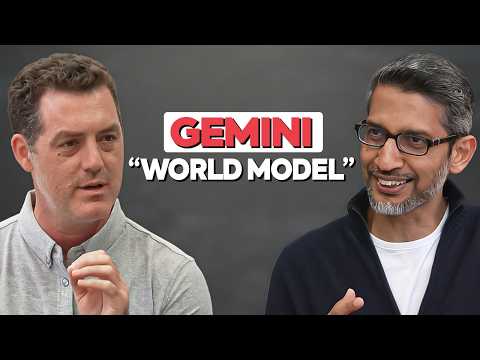
Google CEO Sundar Pichai on Gemini, Self-improving AI, and World Models

May 23, 2025Matthew BermanAI score 10058,867 views

Watch original on YouTube ↗

AI-generated summary

Here's a summary of the interview with Google CEO Sundar Pichai:

This interview dives into the latest exciting developments at Google, focusing on Gemini and the future of AI. It covers new approaches like diffusion models and the concept of Gemini as a world model, explores the potential of self-improving AI, and discusses how these advancements will impact areas like Google Search, agent capabilities, and even hardware form factors like glasses.

Here are the key points from the discussion:

  • Gemini as a World Model & Architecture:

    • Google DeepMind is pursuing multiple paths towards Artificial General Intelligence (AGI).
    • They have separate efforts for the main Gemini models (like 2.5 Pro) and parallel work focused on building "world models."
    • A world model is different from the current mainline Gemini models, but innovations from the world model work (like grounding in physics, seen in VO3) will eventually make their way into the main models.
    • Current mainline Gemini models are primarily auto-regressive Large Language Models (LLMs), which work by predicting the next token.
    • Image models at Google have traditionally used diffusion-based models.
    • They are now experimenting with a diffusion version of Gemini for text, which is a different paradigm than auto-regressive models.
    • The diffusion text model is noted as being incredibly fast (five times faster than Flashlight in one example mentioned).
    • However, the diffusion text model is currently behind the mainline Gemini models in overall capability.
    • Google plans to push the diffusion paradigm as hard as possible and combine it with other approaches where beneficial.
    • The strategy is to make many bets and push different directions in parallel to see how they converge.
  • Self-improving AI & Agents:

    • Something like Alpha Evolve, which allows AI to discover new knowledge and improve itself, is seen as having amazing potential and is considered groundbreaking work by Google.
    • The fact that agents can improve code and make discoveries represents an extraordinary new paradigm.
    • There's a strong feeling that the potential of this technology is still underestimated, even now.
    • Progress is being made with agents, but they currently have limitations like being expensive and having latency, which makes chaining them together challenging.
    • However, Google is actively working on what look like "recursive self-improving paradigms."
    • The potential for self-improving systems is viewed as huge.
  • Key Areas for AI Improvement:

    • A major focus for improvement is making all these AI processes more efficient.
    • Driving efficiency is seen as the key to making AI practical for use at scale everywhere.
    • Google is obsessed with efficiency, which is why they focus on models like 2.5 Flash, designed to bring high intelligence at the best price point – essentially the "workhorse" model.
    • Making everything work efficiently is considered the biggest breakthrough needed.
    • This focus on efficiency is also why they invest in hardware like TPUs, which provide an infrastructure advantage.
  • Agent Memory & Data Portability:

    • Agent memory, which allows agents to learn about a user and become more personalized and efficient, is seen as making agents significantly more powerful.
    • However, giving models memory raises important privacy issues, and ensuring the user is in control of their data is crucial.
    • The concept of data exportability, similar to how users can export Gmail data, is important to consider for agent memory.
    • Thinking about how users can take their AI memory with them if they switch services is seen as a worthy area to explore, although it's still early days.
    • Open protocols, like A2A and MCP, are considered super important for the future of AI.
    • There won't be one AI or one agent; users will likely use many different ones.
    • Understanding how your data is used by different models and potentially making that data portable are seen as valuable considerations.
  • AI Form Factors:

    • AI will show up in many places, but glasses are seen as a really powerful form factor.
    • Glasses allow interaction while you're going about your day, keeping AI in your line of sight and potentially enabling more private interactions.
    • An experience with Project Astra via glasses highlighted the power of spatial memory – the AI could track objects and even figure out when something was intentionally moved out of its view.
    • This intuitive, persistent interaction through glasses is very exciting.
  • Future of Google Search:

    • The Google Search homepage will likely evolve in surprising ways.
    • "AI mode" in Search is seen as a very AI-forward experience that people are adopting naturally.
    • AI mode is grounded in traditional search but can use various tools and incorporate personal context.
    • Over time, Search can become more proactive, for example, prompting a student to do homework or pre-packaging relevant information based on their schedule and context gleaned from other Google services.
    • Having an agent that can see across various user data within Google services and surface relevant information proactively is incredibly important and exciting.
  • Anxiety about AI and Knowledge Work:

    • For people doing knowledge work who are anxious about AI taking over, the perspective is that in the near future, AI acts like a "superpower" or "super assistant."
    • AI should handle much of the "grunt work," allowing people to operate at a higher level.
    • The opportunity lies in leveraging these tools; for example, someone making videos could use AI to quickly generate explanations based on prompts.
    • Powerful tools are being put directly into people's hands.
    • The best way to prepare and stay relevant is to "lean into these tools," test them out, and start using them.
    • Adopting the mindset of having a super assistant available all the time and taking advantage of it is key.
    • Everyone is encouraged to get access to and use these new capabilities.
    • There is strong optimism about the future and the importance of people embracing this technology.

Video transcript

Open transcript
The diffusion version of Gemini, that... It's fast. I was not expecting that. Is this a departure from Transformers or is it something else? So we're going to push the diffusion paradigm as hard as possible. And then where we need to kind of bring them together, we will do that. Are we at that inflection point given it seems like this is self-improving artificial intelligence? We are definitely now working on recursive, self-improving paradigms. What happens to people that do knowledge work? Just lean into these tools. Just getting in the mindset saying, look, you have this now super assistant with you all the time. And just take advantage of it. Do you see the Google search homepage being the kind of first place people go to find things? Sundar, thank you so much for sitting with me. I noticed you announced the Gemini model is going to be a world model, right? You're transitioning to this world model. Does that take significant architecture changes? Is this a departure from Transformers or is it something else? You know, we are, you know, Google DeepMind has always had a broad view of all the things that need to be, needs to be developed for AGI. So they have efforts for the Gini 2 models. They have parallel efforts into building world models, which is different from the main line of Gemini 2.5 Pro. But things we are learning there will make its way there. Like when we built VO3, it's grounded in physics. Some of that innovations came from our work on world models. So that's how I would think about it. And then the diffusion version of Gemini, that was, I was not expecting that. Yeah. So I think it was five times faster than the flashlight. Is that going to start to make its way into this world model? Like, how do you think about all these different architectures? Look, I think first of all, today, all of, you know, mainline Gemini models are auto regressive. LLMs, they are next token prediction models and architecture. Whereas our image models have been diffusion based models. So doing text diffusion, I think it's a different paradigm. As you know, you could see for a same capability, it's so much faster. But it's obviously behind, you know, behind the Gemini mainline in terms of capability. But I think there'll be areas where you can use them. So we're going to push the diffusion paradigm as hard as possible. And then where we need to kind of bring them together, we will do that. And so, but I think it's good to push all the directions in parallel. Yeah. I think that makes sense, right? You just make a lot of bets, push them as far as you can go and see how they come together in the end. That's right. The next thing I want to talk about, so Alpha Evolve. I read that paper a couple of times, saw the project, was absolutely blown away. This is AI that can discover new knowledge, right? And so it really feels like we're at this inflection point of the intelligence explosion. Do you think we have the right ingredients to really, are we at that inflection point, given it seems like this is self-improving artificial intelligence? Look, you're spot on to the potential for something like Alpha Evolve. I think it's amazing. We launched that like a week ahead of IO in this low key way. Yeah. It's one of the most groundbreaking work we are doing. But this, the fact that we spoke a lot about agents today, but the fact that, you know, you can have these agents which can go improve code, make discoveries, etc. What an extraordinary paradigm that is. Yeah. I think this is where we all underestimate, even today, even talking, we so underestimate the potential of this technology. There's been nothing like this ever before. Why I always felt it was one of the most profound things ever, more profound than fire or electricity. But I think when we are making progress with agents today, the models are, you know, they're expensive and, you know, they have latency in them. So when you chain them together to do all this, you know, that's what makes it still not fully there. But we are definitely now working on what looks like recursive self-improving paradigms. And so I think, I think the potential is huge. And if you were to point to one area, whether it's the core intelligence of the model, the memory, the scaffolding around the ages, what do you think is the highest leverage area for improvement? Look, for me, like, look, figuring out how to do all of this more efficiently. So driving efficiency in how all of this works is what's going to make it all much more practical to be used at scale everywhere. Something we've been obsessed about. That's why, you know, our 2.5 flash, which we always are focused on because that's where we bring the most intelligence, the best price point. The workhorse. The workhorse. Yeah. So the more we can. So the biggest breakthrough is to make everything work in that way. Right. Like, you know, and this is why we work on TPUs too. What drives some of that infrastructure advantage. That's what excites me. So you mentioned agents. I know a lot of the presentations today were about agents. I am very bullish on agents. Agent memory in particular is something that I've been thinking a lot about. And it makes agents so much more powerful when they learn to shorthand with you, when they learn about you, they become higher quality, more efficient. But it's also potentially a lock in for large companies. Do you think there's a need for an open source or open protocol similar to MCP or agent to agent, but for agent memory? That's a great question. Look, I think, obviously, when you're giving these models memory, you know, you have to give there are important privacy issues at stake. You want to make sure the user is in control. But I think, like, just today, if you decide to stop using Gmail and you're going to go, we have data exportability. We allow you to export your email. I think, you know, maybe we are in this early phase. But I think these are great concepts to think about time to say, if there is my memory, how can I take it and take it somewhere else as a user with control? But, you know, I don't see why those things are not possible. Going back, I think the open protocols end up being super important. Like, that's why, you know, A2A and MCP are important, exciting directions. I don't think there's going to be one AI to rule them all or one agent. You know, you will be using a lot of them. And so understanding what's your data, how can the models access it, and maybe make those portable. I think those are worthy things to think about. So I went over to the demo booth. I wanted to try on the new XR glasses. They looked incredible based on Project Astra. Do you think glasses are kind of the best, the optimal form factor for this personal and artificial intelligence interaction? And if not, what is it? Or is it a combination of things? What do you think? Look, it will show up in many places. But glasses, I mean, they're really powerful. Because they're just like you're going about your day-to-day life. You're just interacting with things. It is in your line of sight, right? And maybe it can even talk to you more privately, right? You know, it's crap. So I think it's incredible. You just mentioned memory. I just had this amazing experience with Astra where I was just, you know, I showed it a few things. Then I later said, I don't know where an item is in my office. It said, let's play detective. And it thought it knew where it was. But when I went there, I sneakily took the thing away. You know, you could see, say, I just saw it there. Can you zoom back out? It was almost figuring out. I had like kind of pulled that thing away from its line of view. That's so impressive. So, you know, memory. So it was so intuitive to use it. So I love, love that experience. And continuing on the kind of user experience track, five years from now, do you see the Google search homepage being the kind of first place people go to find things? Because it seems like your Google is surfacing all of this context right where the user is, almost proactively. And you can kind of see the vision there. So how do you think about that transition if there is a transition? Look, it'll evolve in surprising ways. But, you know, I'm very excited about AI mode. I've been using it a lot. I see how others are responding to it. It's a very AI forward experience. And people are so natural. They type in so much. But it's grounded in search. It can use all the tools. It will have personal context. And over time, we can be proactive there, too, right? And because you're wearing your glasses, you know, you're a student telling you, hey, you got to, you know, get to your homework. I saved some time on your calendar to do so. And when you go to sit to do it, it has prepackaged stuff for you. All of that, I think, is definitely within line of sight. You know, the details will have to be worked out as we make progress. But this is what we are working on. Yeah, I mean, I'm extremely excited about being able to have – I use a bunch of different Google services, all of my information is there. Having it surface to me and being able to have an agent that can kind of see across all of that data is incredibly important. That I told you earlier, that's why I walked over and bought an Android phone. I want to experience that firsthand when it's ready. So I have another question for you. So a lot of people are anxious about this new world where most knowledge work and maybe eventually all knowledge work can be done by artificial intelligence. And what happens to those folks? What happens to people that do knowledge work? How would they prepare, stay relevant? How do they stay on top of things? I think at least in the near future, I mean, this is like having a superpower with you. It should take a lot of grunt work out. Yeah. Allow you to operate at a higher level. So I think the opportunity is actually, you know, think about with VO3, how many new – I mean, think about you make videos on YouTube. Like, just imagine the future in which, if you want to explain something to your viewers, being able to quickly have a prompt that kind of captures it, inserting it in your video. Like, I think, you know, so we put in powerful tools still in the hands of people. The best way you can prepare is, like, what you're doing. And everybody should just lean into these tools. Test them out. Test them out. Start using them. I always tell people when they come to me and they do something, I'm like, what does Gemini 2.5 Pro think? Did you put – we had I.O. Keynote. I'm like, what did Gemini 2.5 Pro think about the I.O. Keynote? Tell me that. Just getting in the mindset, saying, look, I'm just now super assistant with you all the time, and just take advantage of it. And leaning into it, I think, you know, we're all going to get a lot of access to new tools and capabilities. And so that's how I see it playing out. Yeah, I'm extremely optimistic about the future. I hope people lean into this. It's really exciting. Sundar, I want to thank you so much. It's been an absolute pleasure. Thank you. Thanks.